Coxwell Entrance Closure

MGH's main entrance on Coxwell Avenue is closed as the next phase of our redevelopment project begins. Patients and visitors can use the new temporary main entrance on Sammon Avenue between Coxwell Avenue and Knight Street. View our campus map.

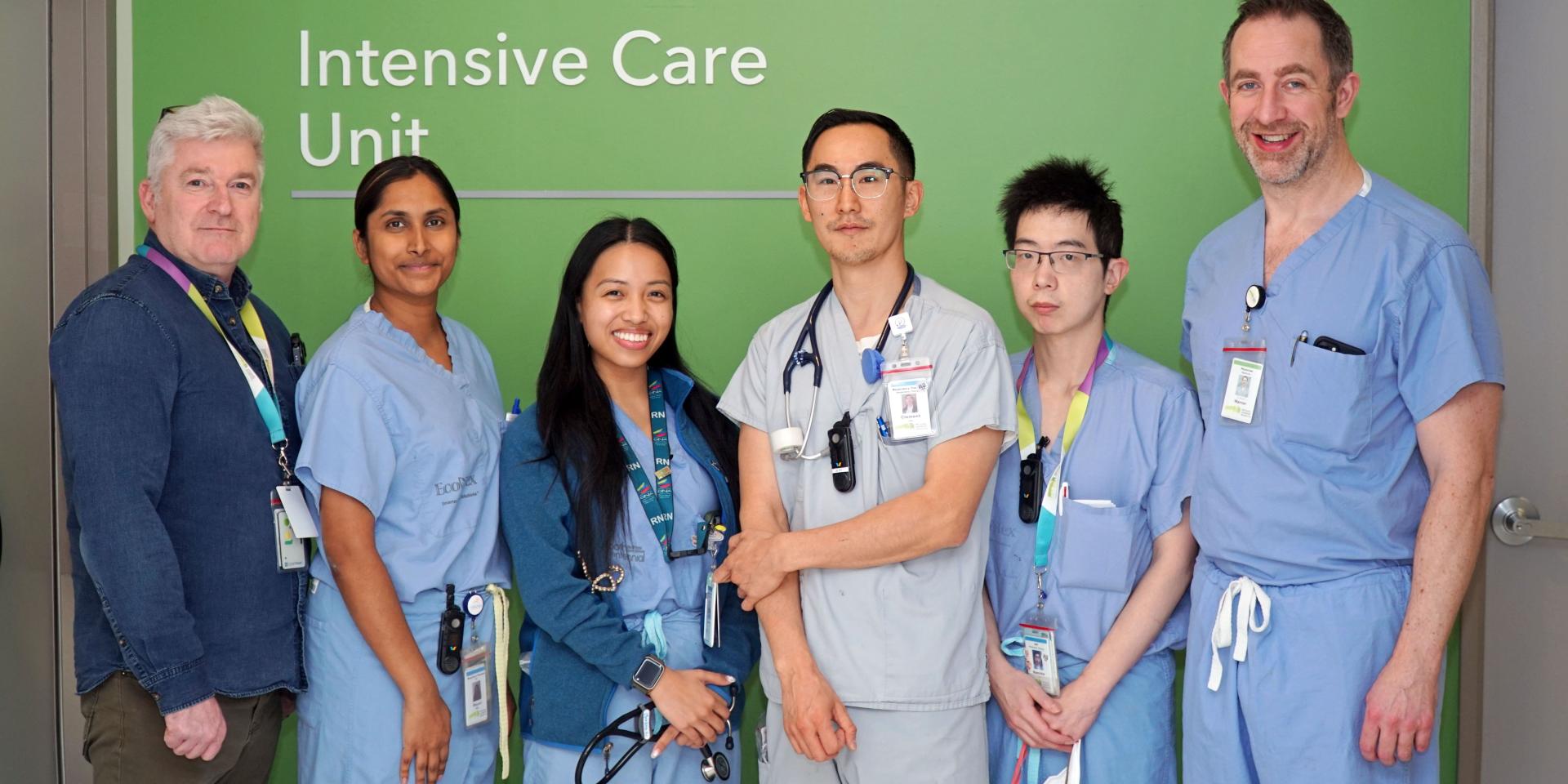
Six members of the ICU outreach team stand in front of a green wall with a sign saying "Intensive Care Unit." Five are wearing blue scrubs, all have hospital badges and are smiling at the camera.
From left to right: Steve Manning, ICU Manager; Mayuri Patel, RRT; Kristine Lisondra, RN, ICU Outreach Team; Clement Hui, RRT; Benson Lin, RRT; and Dr. Michael Warner, Lead Intensivist for the ICU Outreach Team and Chief Medical Information Officer

Staying ahead of the crisis: how MGH's ICU Outreach Team supports patients and staff

As the population ages and the complexity of patient needs grows, hospitals are caring for more people with multiple, overlapping health conditions. The line between stable and critical can shift quickly – sometimes more than once during a single hospital stay.  

Managing patient flow in the hospital can be challenging, but a primary goal is to prevent stable patients from becoming critically ill and entering the Intensive Care Unit (ICU) whenever possible. 

That’s where Michael Garron Hospital’s ICU Outreach Team comes in. The multi-disciplinary ICU Outreach Team supports other clinical units to intervene before a potential crisis develops and ensure the right level of care is always within reach.  

“The ICU Outreach Team helps bridge the gap between ward care and critical care,” says Dr. Michael Warner, Lead Intensivist for the ICU Outreach Team and Chief Medical Information Officer at MGH. “We support teams in recognizing early signs of deterioration, thinking through management and acting early – often preventing the need for ICU transfer. And when a patient does need ICU care, we help ensure that transition is timely, safe and well-coordinated.” 

ICU Outreach Team consult benefits 

The ICU Outreach Team is available at any time for a patient consult. Since the team is multidisciplinary, this includes physicians and registered nurses, with support from respiratory therapists. Although the team does not take over a patient’s care entirely, they can support with any of the following: 

  • educating fellow clinical staff members on complex conditions or flagging a patient whose acuity is becoming critical 
  • coaching staff on medical interventions and procedures 
  • supporting with respiratory distress and interventions needed to alleviate such distress 
  • helping other clinical staff recognize the signs of a patient’s deteriorating condition and preventing cardiac arrest 
  • conducting follow-ups on patients once they are discharged from the ICU 

In practice, a consult can make the difference between a manageable situation and a medical emergency. For example, if a patient's blood pressure is progressively dropping and their overall hemodynamic (how blood flows through a cardiovascular system) status is deteriorating, a floor nurse can activate the team for assessment and guidance.  

What success looks like 

This team, which was formed in 2006, is funded by Ontario Health and is replicated all around the world. It’s a testament to what early intervention can achieve. In the second half of 2025 alone, the ICU Outreach Team completed more than 1,400 consults, supporting teams across the hospital to manage complex conditions and prevent deterioration and unnecessary ICU admissions.  

“Our goal is to empower all our staff to provide the best possible care to each and every patient in the hospital,” says Stephen Manning, Manager, ICU at MGH. “We know we’ve achieved that goal when a patient doesn’t need the ICU at all or when one who needs the ICU gets there at the right moment, with the care team already prepared.”