Coxwell Entrance Closure

MGH's main entrance on Coxwell Avenue is closed as the next phase of our redevelopment project begins. Patients and visitors can use the new temporary main entrance on Sammon Avenue between Coxwell Avenue and Knight Street. View our campus map.

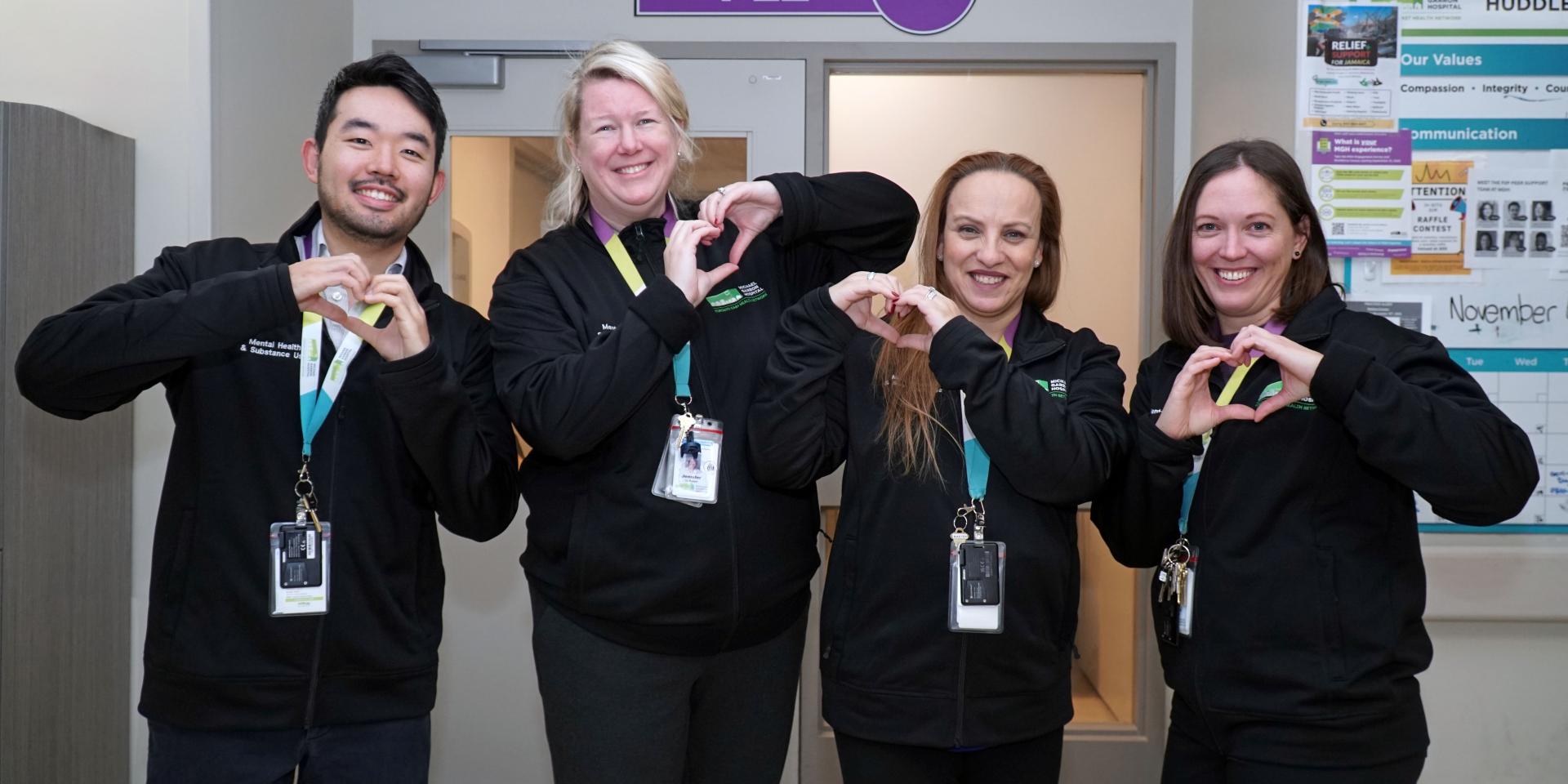
Four staff with badges are making hearts with their hands and smiling at the camera
From left: Dr. Jonathan Hsu, Senior Medical Director, Adult Mental Health; Dr. Jennifer Russel, Chief of Psychiatry; Ifat Witz, Director, Mental Health and Substance Use Services; and Jenna McLeod, Manager, Mental Health and Substance Use Services.

MGH expands mental health and substance use care for patients in East Toronto

Mental Health Week offers a moment to highlight how Michael Garron Hospital (MGH) is expanding access to mental health and substance use care with a suite of new and enhanced programs.  

These include the launch of the new Psychiatric Emergency Zone (PEZ), the Program for Adolescent Transition and Healing (PATH), a new 24/7 Addiction Consult Service and several new therapeutic groups which provide Cognitive Behavioural Therapy (CBT) and Dialectical Behavioural Therapy (DBT). 

Launch of new Psychiatric Emergency Zone 

Last fall, MGH opened its Psychiatric Emergency Zone (PEZ), a new model to improve mental health and substance use care for patients in the Stavro Emergency Department (ED).  

“Like other hospitals, MGH is seeing an increase in the number of patients showing up to our ED with mental health needs,” says Dr. Jennifer Russel, Chief of Psychiatry and Medical Director of Mental Health and Substance Use Services at MGH. “The launch of this new care model is a direct response to these higher patient volumes and the increasingly complex mental health needs of our community.”  

Some of the key improvements in the new six-bed PEZ care model include increased staffing and specialized care, the capacity to accommodate children and youth, improved patient flow and enhanced spaces for patients and staff. 

The PEZ will accommodate shorter stays of up to 72 hours for patients who may not need admission but could benefit from shorter-term stabilization.   

“After stabilization, these patients are discharged with supports and resources, such as referrals to outpatient programs and follow-up psychiatry appointments,” says Ifat Witz, Director, Mental Health and Substance Use Services at MGH. 

Click here to learn more about MGH’s Psychiatric Emergency Zone. 

Launch of new day program to support youth mental health patients transitioning back to routines (PATH) 

Earlier in 2026, MGH launched the Program for Adolescent Transition and Healing (PATH). PATH is a short-term, hospital-based outpatient program designed to support adolescents aged 12-19 who are experiencing mental health challenges that impact their daily functioning and school engagement.  

In partnership with the Toronto Catholic District School Board (TCDSB), the program provides an integrated model of care that combines therapeutic support with academic and vocational programming. Youth attend Monday to Friday for eight weeks while receiving coordinated mental health and educational support in one place. 

“Sometimes, adolescents who are ready to leave acute inpatient care need some extra support as they reintegrate into their school and community. That’s the gap PATH fills, acting as a bridge to ensure these patients are well-supported during the transition,” says Dr. Susan MacKenzie, Medical Director of Child and Youth Psychiatry at MGH. 

The program launched in February 2026 and is already showing strong results. 

“We already have a waitlist that exceeds program capacity,” says Marla Kaye, Manager, Child and Youth Outpatient Mental Health Services, Adult Outpatient Mental Health Services and Rapid Access Addiction Medicine (RAAM) Clinic at MGH. “And repeat visits to the emergency department for these patients after being discharged are currently at zero. That tells us that PATH is meeting a real need for these patients.” 

Introduction of 24/7 Addiction Consult Service 

MGH has launched a new pilot program that has the hospital’s Addiction Consult Service now available 24 hours a day, seven days a week.   

The Addiction Consult Service provides physicians throughout the hospital with access to an addictions specialist who provide advisement on patients with substance use disorders or those who are experiencing acute withdrawal from substances.  

Previously, this program was available at MGH Monday to Friday from 9 a.m. to 5 p.m.  

“For after-hours issues, teams did their best to temper patients until our team was able to provide a consult. But if someone came in on Friday night, they wouldn't be seen until Monday morning, which is a long time,” says Dr. Joel Voth, Interim Medical Director for Substance Use Disorders and an addictions physician at MGH.  

Thanks to the new pilot project, an addictions medicine physician is available on-call during evenings and weekends to provide support to MGH physicians over the phone. 

Since its launch in late November 2025, the program has provided 45 after-hours consults. 

“Being able to provide a consult sooner means that the patient gets better treatment,” Dr. Voth says. “And if they get stabilized faster and sooner, it means that they might not actually need admission. So, it can also shorten the patient's time of stay in hospital.” 

In addition to being beneficial for patients, this service is helpful for the physicians and staff in the ED and inpatient units who do not specialize in addiction medicine. 

“Treating patients with acute withdrawal syndromes can be challenging, and often the dosing we recommend is outside of the comfort zone for providers, so they value our expertise,” Dr. Voth says. “Due to the more toxic drug supply we are seeing, treating these issues continues to get more and more complicated.” 

Providing new therapeutic CBT and DBT groups for MGH outpatients  

In early 2026, MGH’s Adult Outpatient Mental Health Services launched several therapeutic groups that provide patients with Cognitive Behavioural Therapy (CBT) and Dialectical Behavioural Therapy (DBT). 

These include a DBT-based skills group, CBT for depression, CBT for insomnia and CBT-based Geriatric-Focused Building Balance Group. Patients are referred to these short-term programs, which may include a mix of virtual and in-person sessions, depending on the group's needs. 

DBT and CBT are evidence-based therapies that use several frameworks to help patients experiencing a range of symptoms manage their conditions. This can include developing a higher tolerance for emotional distress, or the skills needed to identify and reduce the cognitive distortions causing emotional pain.  

“The group format also brings its own benefits,” says Kaye. “Sometimes it’s particularly valuable for patients to connect with others who are experiencing similar mental health challenges, to have this lightbulb moment of ‘I’m not alone in this.’” 

Across all four programs at MGH, the goal is the same: ensuring East Toronto residents can access the right mental health and substance use treatment, at the right time.